A few days ago I made some updates to COUNTA’s Competition feature. The original goal was to tidy up a few PHP upgrade issues, but I ended up enhancing the functionality as well.
It was a slightly fraught process, and in truth it probably wasn’t the best use of time. The finished improvements weren’t massively beyond what was already there, and a lot of the effort went into exploring “good ideas” that sounded exciting in theory but weren’t essential. ChatGPT suggested that competitor analysis should include snapshots, and I agreed. About 8–10 hours later we’d implemented that one “good idea” and, sensibly, left the other ten ideas parked for another day.
Even so, the whole experience made me step back and think about the feature itself.
A feature that’s been around for 15+ years
Competition analysis has been part of COUNTA for well over 15 years. It’s intentionally simple: you add competitor websites (or any websites you want to keep an eye on) and use that list as a reference point over time. The idea is that you make of it what you want. It’s not meant to dictate a process, it’s meant to give you a place to collect useful information and observations.
And yet, not many people use it. Some clients seem slightly put off by the idea of “competitors” in general. A common reaction is along the lines of: “We’re not really in direct competition,” or “They’re much bigger than us,” or “They’re not the same as us.” All fair points — but they also miss the point a little.
Because competitor tracking isn’t only about direct rivals. It’s about making sure you’re not missing something obvious in your market: how others present their services, the trust signals they use, how they price, what they emphasise, what features they highlight, and what kind of content they publish.
The moment I realised it isn’t a gimmick
What really brought it home for me was remembering that I used to do this in print form.
I still have a physical folder I prepared on 31 July 2009 at around 9.30pm — complete with the cover sheet and a print-out of my own website as it looked at the time. Inside, there’s a list of local competitors, many of whom no longer exist. That alone is a reminder that this sort of tracking isn’t a gimmick. It’s a genuine business development habit: a simple way to keep your bearings over time.

“Competitor benchmarking” — and why it matters
More recently, I was looking at a company that isn’t a direct competitor at all — it’s a larger business — while thinking about how to position my software development services. What struck me was that their Discovery phase explicitly lists Competitor Benchmarking as an active item.
That immediately reframed how I think about COUNTA’s Competition page. It’s not an idle feature with limited application. It’s a practical tool for measuring your own site against what’s happening around you. In fact, it was through a bit of benchmarking that I first introduced COUNTA’s development cycle feature on my own site. You could say I “copied” the idea — but that’s really the point. Seeing something done well elsewhere can nudge you towards improving your own work.
The irony: mine isn’t well used
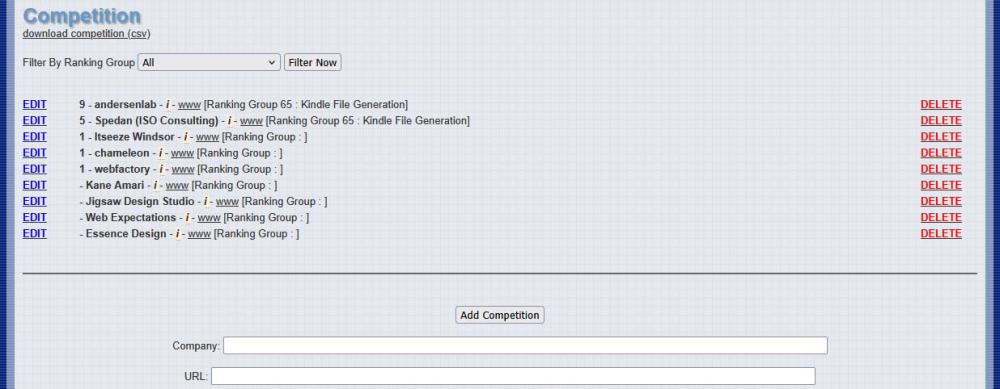
Below is a screenshot from my own site. The amusing part is that it’s not particularly well filled out — and this is on my own system, which I’ve had for 15+ years. It’s also not especially attractive.
I did try to improve the design, but ChatGPT made such a mess of it that I reverted back to the basic layout. Most of the effort ended up going into the snapshot feature, which was useful, but also a reminder to keep enhancements proportionate.
What the feature actually does
For context, the Competition feature has always grabbed keyword tags from the target site as a simple reference point. It’s not critical, but it’s often interesting.
The update expanded that slightly: it now pulls in more metadata (title and description), along with main body content and a few other bits, and stores a snapshot so you can see how a site changes over time. Useful, but not exactly earth-shattering. Still, it adds a bit more substance for anyone who wants to use the feature properly.
Why I’m writing this
I felt compelled to write this for two reasons:
-
I’m naturally drawn to documenting small improvements like this, especially when they connect to wider thinking about business development.
-
The idea of competitor benchmarking was conceptually reinforced for me in two different ways: seeing it listed as a formal part of another company’s process, and realising I’ve been doing my own version since at least 2009.
If you’re reading this, it’s worth asking: have you ever benchmarked your own website properly? Do you have a simple, repeatable way of doing it? Not in the abstract, but in a way that actually turns into actions over time.
Yes, the obvious cross-sell is that if your website is hosted and supported by TWS, tools like this are available to you — and you’ve got me on hand to help you use them properly. But that isn’t the main point of this post. This is really just a reflection on a recent update, and a reminder that competitor benchmarking is a genuinely useful concept, however you approach it.
Clearly, I could do with updating my own list. Maybe that’s a decent New Year’s resolution.
One final note: it doesn’t have to be “competitors”. You can add any site you have an interest in — design inspiration, features, positioning, layout, calls-to-action, whatever. Like many COUNTA features, the application isn’t rigid. It’s there to be used in whatever way helps you make better decisions.
And one more final final note, obviously, considering my recent AI integration service, you can now either manually or dynamically monitor your competition now with AI with prompts like, give me all the competitors within 5 miles of me. Amazing really.
 “TWS has over 24 years experience in website design and management.”