I’ve always loved those old paperback Sci‑Fi covers — vast ships, alien skies, and some unlucky explorer in the foreground.
So I set out to recreate what, to me, is the archetypal image: a colossal colony ship wrecked on an alien world, with a lone astronaut’s remains nearby.
Here is my finished version. (note, the images are in reverse order of creation, the first ones being at the bottom of the page)
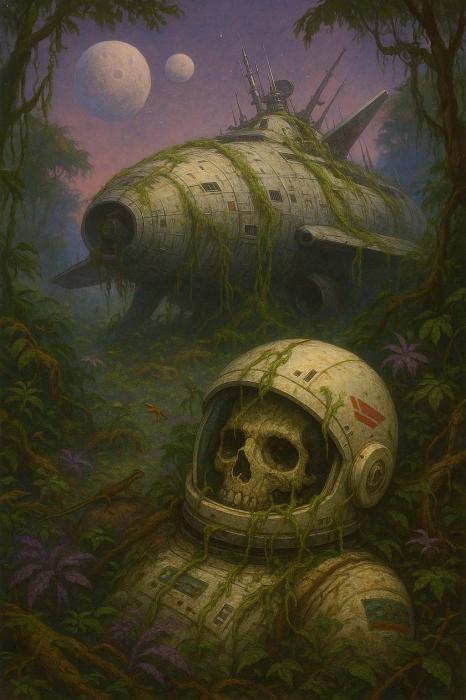
The short version
Generating these images was fast and honestly pretty fun. With roughly half a dozen prompts and a few iterations, I had a result I liked. I wasn’t making them for anything specific — I just didn’t want them to go to waste — so I’m posting them here along with a few thoughts about the process.
What worked (quickly)
AI image tools make it easy to produce a single, striking illustration without traditional art skills. You can go from idea to something quite presentable in minutes. The strength is in speed and exploration: try a jungle, then a swamp, then the same scene at dusk with twin moons — you’ll get decent results for each in very little time.
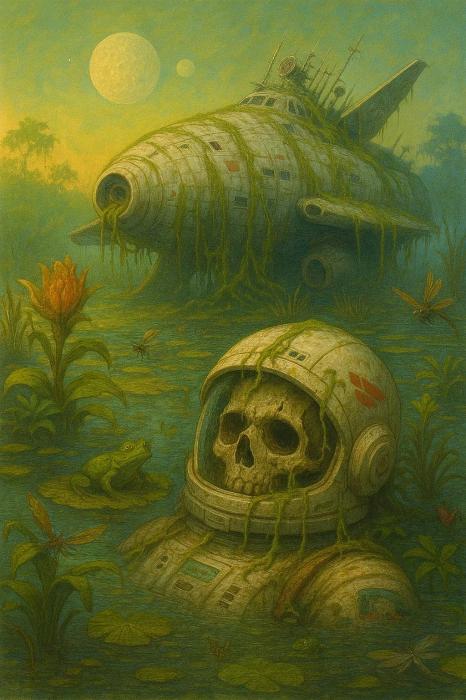
In this second version of my finished version I tried to change the environment.
The tricky bit: consistency and variety
Where things get awkward is when you want both continuity and difference. I asked the model to keep the same ship and astronaut but change the environment — alien jungle vs. alien swamp — and the results were close yet not truly consistent. The hull panels shifted, the cockpit changed, and proportions wandered. If this were for a comic, a picture book, or a storyboard, those subtle changes would become loud very quickly.
I was happier with this, but I wanted antenna on the spacecraft and some form of apparent propulsion, as well as a crack in the helmets visor.
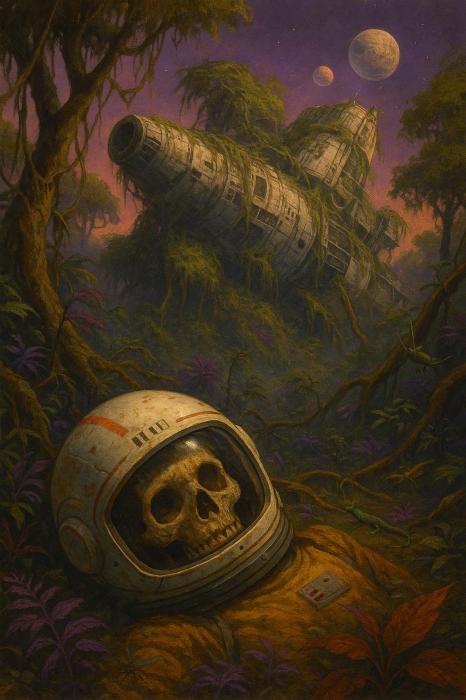
At the same time, the scenes weren’t different enough to feel like intentional variants of the same subject; the ship design converged toward a similar look each time. So you end up with a paradox: it’s hard to get precise sameness where you need it, and hard to force real divergence where you want it.
Practical ways to improve continuity (still a work‑in‑progress)
-
Reuse a strong reference image and build variations by editing or in‑painting around it, rather than regenerating from scratch.
-
Keep composition anchors fixed (camera angle, distance, horizon line) and only swap the environmental descriptors.
-
Use consistent naming/markings in the prompt (ship designation, emblem shapes/colours) so the model has cues to repeat.
-
When available, lock settings such as seed/aspect ratio to reduce drift across outputs.
These help, but even then, continuity remains fragile. For long‑form, frame‑to‑frame storytelling, a human artist still has a clear edge.
Where AI shines right now
Single, stand‑alone images: book covers, hero banners, mood pieces, concept frames, and quick mock‑ups. If you need one powerful visual, AI gets you there quickly. In a commercial context, creating a bespoke banner for a website hero could take 20–60 minutes — about the same time you might spend iterating an AI image to a usable state. It’s not a replacement for craft, but it is a practical tool for fast visual problem‑solving.
This is one that I was more happy with, but I thought the astronaut looked like he was standing up, so I adjusted the prompt. However, the ship does look more vast in proportion.
On the value of the “AI artist”
There’s a school of thought that says AI art isn’t “real” because prompting isn’t a skill. After experimenting, I think there is a skill here — art direction. It’s choosing the right descriptors, iterating tastefully, enforcing constraints, noticing when the model drifts, and knowing when to stop. The bar to entry is low, yes, but the difference between a random output and a purposeful image is still largely down to human judgment.
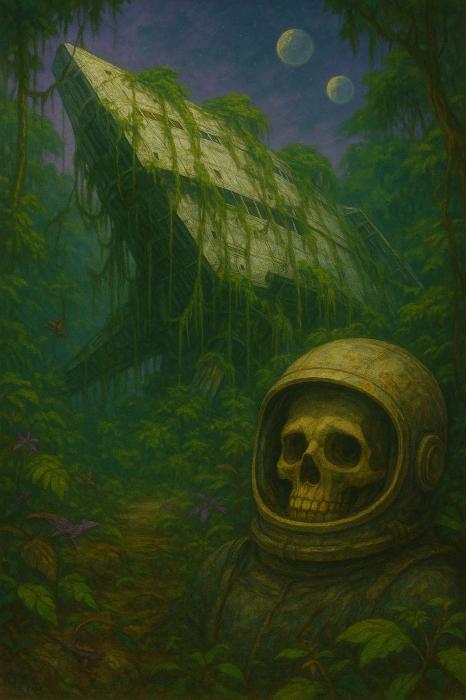
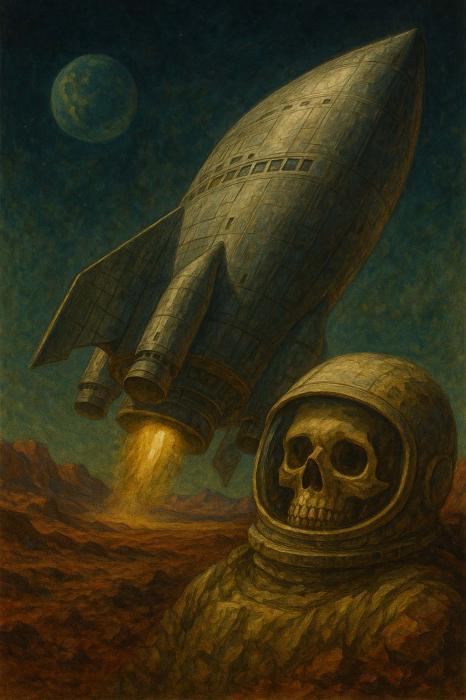
This was my second attempt, and it still looked too retro, the spaceship looking more like a rocket from the 1902 A Trip To The Moon, and not like the epic imaginations of the 1960s and 1970s sci-fi that I was trying to replicate.
What I plan to try next
I started with the classic jungle scene, then pushed into marshland. I’d like to repeat the idea across a frozen tundra, a high‑altitude mountain basin, and a desert with razor‑thin spires — keeping the same ship identity and insignia while letting the atmosphere and ecology change. If continuity holds up well enough, great; if not, that’s useful data too.
Side note: If you’re considering commercial use, always check usage rights for the tool you’re using and keep track of your sources and edits.
Final thought
This began as a nostalgic experiment and a place to park the images so they don’t vanish into the ether. Along the way, it clarified where AI helps (speed, exploration, single visuals) and where it struggles (tight continuity over many frames). For now, I’m happy to treat these as part of a growing sketchbook — not thrown away, but collected as small steps in figuring out how AI and human direction overlap.
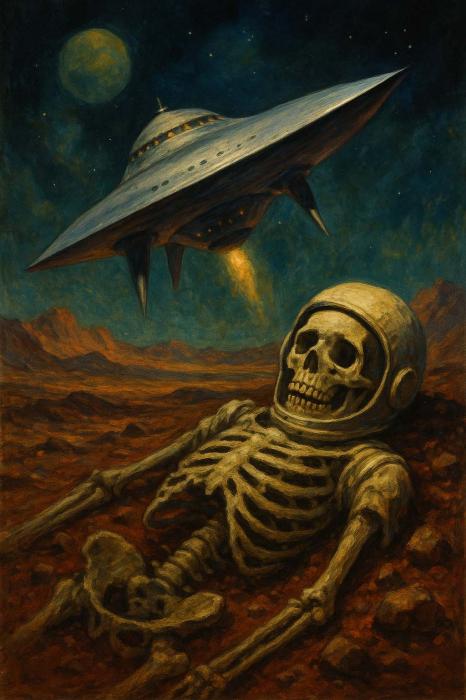
My first version was not what I was after, the flying saucer looks like, well, a flying saucer, not a commercial space vessel for some advanced cargo or exploration service of the future. Also, the skeleton was too blatant, I wanted something more subtle with only a hint of the skeleton
In conclusion, I am happy with most of these images, but they are still not exactly what I wanted. I didn't use any reference, I wanted a vast spacecraft as we see in many films and book covers and I don't think the AI really achieved that. But considering these are just an idle doodles I am happy enough. For reference, I think I have spent as much time writing the blog as I did creating the images.
Either way, I think its clear the potential is incredible. I would never have been able to produces these two years ago, and clearly if I had more time and an imperative, I could really get anything I wanted.
 “TWS has over 24 years experience in website design and management.”